Seattle Interactive Conference – SIC2011 – Day Two

Day two of the #SIC2011 conference was well attended, with a slow start due to the party last night :-) . I attended quite a few sessions, with mixed results in terms of quality. The Spring Creek panel on Social Media ROI was lame and I was hoping for some more specifics and action items out of the Yelp and Ubermind/Alaska Airlines sessions.

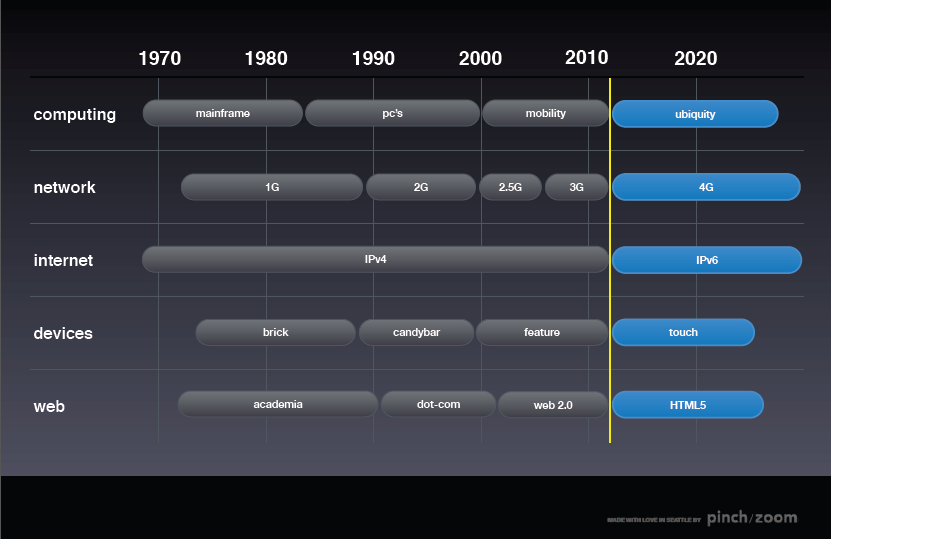
On the good side was Rand Fishkin – he and I are totally aligned on Content – Social – Search – Conversion working together for earned media, but I don’t think he went far enough. I’ll have a post on this in the near future. The session by Brian Fling on mobile development was great – he had one slide that showed a timeline of technologies: computing, network, internet, devices and web transitions and why we are at a major transition point (see below). The Digital Music panel and the So-Lo-Mo (Social, Local, Mobile) were both great.

Sessions I attended:

  •  Rand Fishkin – Inbound Marketing is All Connected – Presentation @ http://bit.ly/inboundconnected
  • Brian Fling – Pinch/Zoom – Mobile Design – Get Slides! @fling, book: mobiledesign.org
  • Yelp – Darnel Holloway – Local for Business
  • Digital Music Panel – Ross Reynolds (KUOW), Aaron Starkey (KEXP), Nick Harmer (DCFC), Sir-Mix-A-Lot, Tim Bierman (Pearl Jam Ten)
  • Social Media Panel – Measuring ROI – Kevin O’Reilly (Spring Creek), Ben Straley (Meteor), Neil Beam (Conversean), Julie Storer (HTC)
  • Mobile Experience – Alaska Airlines (Curtis Kopf) and Ubermind (Shehryar Khan)
  • SoLoMo – Social Local Mobile Panel – Scott Macklin (UW MCOM), Bryan Trussel (Glympse), Daniel Cowen (Echoer), Jason Wilson (MapQuest), Monica Guzman (Geekwire)

Rand Fishkin – Inbound Marketing is All Connected – Presentation @ http://bit.ly/inboundconnected
- Why did we become a marketer? To push? Interrupt?
- You can’t buy my business, you have to earn my business
- Inbound Marketing – any tactic that relies on earning people’s attention instead of buying it
- Additional decks: social media marketing + seo
- Content > Search > Social > Conversion
- Search is still a big deal and growing – Google – 3 Billion searches per DAY
- Social is Discovery Prior to Interest = awareness?
- A front page post of Reddit will drive 50k – 100k referrals to a site. A top post with some longevity will drive 250k+
○ Kimpton: thanks for visiting, anything we can do? > I want bathtub full of reeces pieces and a bed full of kittens > We’ll see what we can do > arrives to a note card with a bathtub and bag of reeces pieces + photo of kittens on bed > takes picture, submits to Reddit – 100,000′s of visits > BIG ROI
- Top three positions covered by SEOmoz – third position was a video – more clicks on 3rd position than first two
- Conversion: listen/survey > why did you buy, why didn’t you buy? What do you like/not like? What is confusing/clear?
- What you say > how you say it
- Trust happens “out there” not just on Landing Page
- Tips/Steps
○ #1: Data as Content Marketing
○ #2: Video Content + SERP Visuals – SEOmoz uses http://wistia.com to host and measure videos to embed on site – link points back to SEOmoz NOT YouTube and send and submit videoXML site map for you
○ #3: Thought Leadership + Rel=Author – Author markup, connected to Google+ (see social media kpis)
○ #4: Social Networks for Personalized Rankings – using social to personalize results
○ #5: Link Building w/ Your Social Followers – use export.ly by Simply Measured > Klout Score > Good people who are following me who have good sites who are not linking to me. LinkedIN, email lists, other connected sources.
○ #6: Long Tail SEO via Gamification – Quora uses a point system, 80% complete
○ #7: PR through Social Outreach > followerwonk – search by profile description “bend journalist”
○ #8: Viral-Worthy Content via Q+A Research > what do people care about in your niche? Google discussions, Quora, what are people asking for?
○ #9: Influence Search Suggest through Branding > Google – not logged in > generic term brand > “travel blog everywhereist” example
○ #10: Leverage Thought Leaders to Build Content > survey people in your biz, ask an important question (how much do you charge for a website), collate and present data, survey responders and others will link to it

Brian Fling – Pinch/Zoom – Mobile Design – Get Slides! @fling, book: mobiledesign.org
- We are in the third major stage of mobile
- Mobile experiences are NOT made in Photoshop or Basecamp
- “We could build the best mobile app in the world, but if the client doesn’t understand it – it could be the worst app in the world”
- Mobile is REALLY hard
- Business Goals + Technical Goals + User Goals > sweet spot is in the middle of equilateral triangle
○ Ex: technical – dispense soda, business – improve productivity, user – satisfy thirst quickly
- Apple Strategy against innovators curve
○ Refresh product lines before they become tired > OK with just 50% of market
○ A bold vision empowers people to cross the chasm together
- Social media is not a thing – it is pervasive across everything
- I love the slide that overlays time lines with computing, network, internet, devices and web transitions – get slides?

The timelime of web-mobile technolgoy

Pinch Zoom Web Technology Time Line

- Massive convergence of ubiquity + 4G + ipv6 + touch phones + HTML5
- Pinch/zoom – mobile bootcamp > get slides!
○ Get brands on mobile path quickly
○ Create shared vision of how mobile is meant to improve vision
- Challenges
○ Platform aesthetic
○ Many resolutions
○ Pixels per inch
○ Orientation
○ Design grids
○ Perspective
○ Dimensions
○ Interactions
○ Motion
○ Transitions
○ Color
○ Typography
○ Iconography
- Phones (currently) are about short, simple tasks (less than 5 minutes) and context sensitive
- Inverse Journalist pyramid is a good model: Most Noteworthy Info (who, what, when where, why, how) comes FIRST, then details. Can leave anytime.
- Tablets are about focus + consumption + portability
○ Swipe vs scroll

Yelp – Darnel Holloway – Local for Business
- Transactional interactions
- Younger audience – 18-34, but affluent – money to spend
- 80% of reviews are positive (3 stars or more)
- Restaurants are largest group, but shopping is close secon
- Quality control for reviews
○ Users can take down own reviews > restaurant had responded, reached out, fixed it > reviewers take it down or update
○ Set of reviewer guidelines > no hate speech, have to represent first hand experience, no conflicts of interest
○ Automated review filter > suspicious reviews and reviewers – fake profiles, fake reviews, cottage industry
- Biz.yelp.com > starting point for business owners
○ Respond to reviewers > join the conversation
○ Reviews are a form of market research > look at competitors as well
○ Respond privately or publicly (don’t freak out)
- Recommend others on your Yelp listing to get them to recommend you
- Post check-in offers in Yelp > similar to FoureSquare > check-in can post to Twitter and Facebook like 4Square
- Consumers are looking at overall trends not necessarily individual bad reviews
○ Engage the bad review in a polite, respectful way

Digital Music Panel – Ross Reynolds (KUOW), Aaron Starkey (KEXP), Nick Harmer (DCFC), Sir-Mix-A-Lot, Tim Bierman (Pearl Jam Ten)
- Napster and broadband changed everything
- Transactions happen all the time > monetary and musically and interpersonal communication
- Digital has benefited fans the most > lost the radio filter
○ Cream rising to top > walking talking brands
- Easier to spread word about music
○ Musicians are spending as much time thinking about how to connect and share vs practicing and writing
○ Content, video, conversations way more time thinking about generating content and connecting to events
○ A lot more work involved now
- Is radio less important now?
○ Independent radio is needed, Comcast type mega stations/format are dying
○ There is so much music that the stations have to listen to listeners more
○ The future is IP connectivity
- So many options I don’t know what to do – smaller, trusted radio stations help guide
○ Delivered via airways vs via Internet – the personal touch is important
○ More than just jumping in a van and going on-tour
○ Hire a social/marketing firm instead of a record company
- Two way communication and how people interact
○ Social networks have huge influence > reviews, recommendations, radio choices – replacing the record store guy
○ Spotify > what friends are listening to
○ Ambassadors – many more out there -who do you trust? Who do you spend your time listening to
- Crash and Burn Tactics
○ Trying to manufacture a viral event/piece of content/fake website
○ Underestimating the connection speed available and how to balance cost vs audience
○ Not ready to support a success event – special tickets, items, new sales, etc. Server crashing, slow, bad experience
○ Video about exotic cars > do not buy views on YouTube – bought 30,000 views to get rolling, but audience was looking for Ferarri’s not Mix A Lot
- Success Tactics
○ Last album, 1st video – live-one take video-happening live-recorded and shown all at once – streaming in HD while making it
○ Underestimating the success of videos – Florence and Machine – 100k plus views of in-house
○ Local photographer – Chase Jarvis – Shot album cover based on what the audience wants you to wear – kept going and going
- There is a glass ceiling on touring revenue
○ You can only do so many shows for so long in your life
○ At what point do you stop touring and continue to monitize your music
- Younger artists
○ Fame first > I had 2,000,000 downloads of our video! For free!
○ How do you start making money to support the music?
- Social tools for audience development
○ Maps, cell phones, Twitter
- I can define myself now vs going through the publicity department or DJs
○ Lady Gaga re-defines herself on a weekly basis
- How do you support the giant middle class of working musicians
○ Longer careers
○ Bigger middle class of musicians
- Recored labels have shifted the contract
○ Not a record deal, but a full package deal: concerts, images, likenesses, downloads, streams, t-shirts, everything
- Future of Music
○ Celestial Jukebox coming
○ Free music, everywhere – 4G (LTE) connection speeds
○ The way we make music > big divide in terms of production of music – higher quality, virtual collaboration
- Mix misses the “Mystique” of artists – transparency can work for a lot of folks, but not everyone
○ I don’t want to see Prince eating BBQ :-)
- Contract process has to speed up
○ It should not take 3 weeks to license one song

Social Media Panel – Measuring ROI – Kevin O’Reilly (Spring Creek), Ben Straley (Meteor), Neil Beam (Conversean), Julie Storer (HTC)
- Email – when new – experienced the same issues
- What is the business objectives?
- If you could track one metric, what would it be
- Direct measurement vs indirect measurement
- Long cycles, multiple touches, on-going conversations
- What are the transactions that you can and should measure > what was the financial impact
- Influencer Campaigns
○ Macro influencers (Justin Bieber), Micro Influencers (Matt Cutts at Google)
- Engagement as a metric
○ How to define

Mobile Experience – Alaska Airlines (Curtis Kopf) and Ubermind (Shehryar Khan)

- Work with leading companies
- Game changing, disruptive solutions > what is different, compelling
- Deep expertise in mobile and what it means
- Mobile is not a project > it is a long term channel and strategy
- Had to be designed for agility – iterate rapidly and often
- UberInsights
○ New to airline industry’s underlying complexity
○ Availability of backend services
○ Leaving “platform solution for truly custom app
○ Differentiated mobile strategy
○ Apply lessons learned from other industries
- Principles
○ Start with customes > not just an Alaska customer but what are they used to on mobile
○ Simple, intuitive experience
○ Be different
○ Seamlessly integrated teams
○ Be agile, learn and adapt
- Scenarios
○ User interface – the “flight jacket”
○ Mobile boarding pass
○ Responsive to customers changing needs
- What Helps
○ Committed product owner
○ Embrace agile development process
○ Tem chemistry
○ Constant feedback loop
○ Living, eating, breathing mobile

SoLoMo – Social Local Mobile Panel – Scott Macklin (UW MCOM), Bryan Trussel (Glympse), Daniel Cowen (Echoer), Jason Wilson (MapQuest), Monica Guzman (Geekwire)
- Where are you, where am I, what are we doing?
- Layer of utility and enhancing social relationships > connecting to places
- Help me make a decision about what is worth doing, what do my friends
- 350 million mobile Facebook apps, more smart phones purchased than not for the first time
- Where do you want to meet?
- I am here, come get me
- Find/attach one need
- Becomes more useful as more people are on it (the app)
- Phone has eyes (camera) it knows where it is (geo-location) > point the camera at something to get information – replaces the need for key input
- Read Snow Crash – merger of CIA with Library of Congress
- Sharing and generosity is at the core
- Privacy
○ They used to call it stalking, now they call it location based notification
○ Privacy means different things to different people
○ Share your location for a limited time frame, only you can send the Glympse > different for various situations
- Building the slo-lo-mo infrastructure
○ Like building a city > you didn’t start out saying how are we going to monetize this road
○ We will be surprised with what will come out of it
- Lots of Gadgets and how they are uses
○ Google maps, kindle, iphones, etc.

Seattle Interactive Conference – SIC 2011 – Day One

I attended the Seattle Interactive Conference today (#sic2011) and wanted to share my notes. There were lots of great sessions, but I could only attend four. Best session I attended was the first – Sean O’Driscoll from Ant’s Eye View and his stages of social media program – “the journey”. I really liked how he laid out the five steps of the journey to a fully engaged social media program.

Conference thoughts: The place was packed with people but the space is not laid out very well – especially the registration. Before 9am there was an hour long wait for passes – the ops team blew that piece. I was there a bit early so missed the mass lines, but many folks missed the opening sessions.

I really enjoyed the range of topics: SEO, Social (lots), Mobile, Design, UX, Cloud – very cool

Sessions I attended with notes below:

  • Sean O’Driscoll – Ant’s Eye View – Practitioner’s Guide to the Social Engagement Journey
  • Vanessa Fox – Getting Out of the SEO Silo
  • Dan Gerber – Pop – Camping Out – Setting the Foundation for Interactive Design
  • Panel – Beyond the Hype: Social Media and Business 101 > social features to the enterprise
  • Ben Elowitz – Wet Paint -  The Social Operating System

Sean O’Driscoll – Ant’s Eye View – Practitioner’s Guide to the Social Engagement Journey

  • Educate large brands on how to integrate conversations into their workflow > how to be nice to your customers
  • Where should you post your status graph – find
  • Business strategy vs a twitter strategy or social media strategy or facebook strategy
    • It’s not about being “on” or “off” the social web
    • Are you a “fully engaged” enterprise > it is a journey defined by stages of operational maturity
  • Five stages of the journey
    • Traditional – listening to what people are saying, not engaged, conversation passing you by
    • Experimental “the arrival of the mavericks” – someone reaches out to do something, entrepreneurial ins spirit
    • Operational – someone is given budget and authority to create strategy, materials, hire > more in an influence role as a lot of contacts happen outside of the “marketing” group. Frustration about metrics starts to bubble up, what does an engagement metric look like? What does it look like?
    • Measurable – start to track business impact, broken through functional silo’s, defined success/influencers identification/engagement strategy and approach. Strong orchestration.
    • Fully Engaged – Everybody has the opportunity to take action in a clear way, with process and clear roles
  • Pathways to the Engaged Enterprise
    • People and Process – what is the strategy? Is it written down? Clear business objectives? Measurable goals against timeline, set initiatives, tactics – costs, timeline (one page – plan on page)
    • Education – policy and guidelines are necessary, but not sufficient. Need to know and share the “how” and not just the “what”. Use a series of playbooks “how to do a Facebook contest” At Dell > only one way to do a Facebook contest and here are the two vendors -  prescriptive guidance is important as you pass education through the organization.
    • Channels & Technology – balance the needs of the business, resourcing realities, and platform independencies. Do your tools just take a pulse (listening and monitoring) or are you effectively distributing the use and competency across the organization. Do you want more data or more insight. Insight > connect information to outcomes and routing to people that can do something about it.
    • Insights and Analytics – How are your metrics comparative? I’ve got 200 likes – is that good? Contextualize your outputs based on your business, size, industry and competitors
    • Activation and  Execution -  Start with an  insight, not an idea. Businesses that win build relationships Begin with advocates. Using the Agile Marketing Approach process to identify customer stories, tech/activities to solve, sprints to get there.  Working across teams in scrums.
  • Tips from Sean
    • Start with a customer need
    • Executive buy-in is key
    • Real results lie “between the seams” – between operational and organizational functions
    • Look for early wins, set expectations
    • Measure for impact
    • Kotter: look for a case for urgency + create a coalition of resources that can support and execute
    • Google+ is like a third sock. It may be a great sock, but I only have two legs. Kick ass on the legs you have.

Vanessa Fox – Getting Out of the SEO Silo

  • Showed an example of Hasbah Tamadot website is all images > basic SEO tactics
  • Getting the basics right important for big brands
  • Search terms and researching happens from a lot of different angles and stages
  • Who is your audience?
    • What audiences search for
    • What audiences talk about
    • Market research, email open rates, on-site behavior, etc.
  • How do you solve their problems?
    • What information/content type will satisfy the general need
  • The Personal Lifecyle – book for usability
  • Business Objectives
    • What is project goal?  What does success look like?
    • What is brand objective? What lasting impression?
    • What is value proposition? What makes you different?
    • What are conversion events and engagement events? What makes you money?
    • Who are key audiences?
    • What motivates them?
  • How do we solve peoples problems?
    • Google correlate > correlated terms
    • Discussion link > what are people talking about?
  • Pick an event or audience > what are their key questions?
    • What time does the SuperBowl site? Key audience in local market. Should be important text in the TV website
  • Client impact ideas
    • Review title tags, meta descriptions and destination pages for alignment of copy to expectations to website
    • Persona’s – how can we grow this element of our services

Dan Gerber – Pop – Camping Out – Setting the Foundation for Interactive Design

  • Camping is group and individual
  • Camping is a process: packing, getting there, setup – camping = fun – take down, blue tarp for rain,
  • Interactive designers – strive to create meaningful relationships between users and design
    • More than wire frames
  • IxD shoud be:
    • Data-driven
    • User-driven
    • Goal-driven
    • Idea-driven
  • Step One – Embrace Discovery
    • More than: order taking, check-box checking, creative brief (need more, need to dig in deep)
    • Should explore: User motivations, behaviors + context, user empathy
    • Is best with: success goals, experience KPIs, strategic concept + direction
  • Step Two – Expand the Role
    • Own the problem: build on data, tackle business goals with user goals, define success on and off the device > drill in to true user research and understanding
    • Experience strategy: user research, behaviors + motivations + emotions +  propensities, UX discovery tools (analysis,  personas, journeys)
  • Step Three – Own the Concept
    • Strategy + Design: UX at core of the concept, concepting before + beyond the visual, strategy big + small
  • Even some of our industry best practices ASSUME too much
    • Different approaches are great, but need to dial in to project
  • Example – Defining a mobile app concept – Seattle Sounders
    • Challenge – design a club app, not a league app for mobile
    • The team is important, but so is the experience at the game and what it means to be a sounders fan vs a specific player fan
  • So how do we get to a concept?
  • Concept Setup
    • Adaptable research: internal brainstorming, 300 fan comments on facebook, fan survey, flickr audit, literary review, stadium shadowing, global app review, group audience interviews
  • How do you know when you have enough to design something great?
    • Driven by time/schedule?
  • Sounders  PULSE – maintain pulse of fans throughout the engagement
    • Fans wanted an app to drive engagement between the games
      • Fans can follow the emotional state of the match and team – authentically
      • “scarves up vs scarves down” poll result
      • Contant, quick social connections to community + team
      • Balance between club app v. fan app
      • Use cases that play to fan contexts
      • Streaming audio – stream games if not there – connect with those who can’t be there – 40 countries using streaming app
      • Red card/yellow card – easter eggs, take advantage of emotion – shake app to make screen go yellow > swipe to go red
  • When UX is involved in concepting, UX can guard the strategy throughout execution and delivery
  • Challenges
    • Multiple concept owners: some tension good/some is not, creating idea advocates – not consensus
    • Keeps IxD’s away from prototyping: Builds other strengths, increases user empathy, tracks business goals
    • New skills: stretches thinking from tactics to strategy, beyond comfort zone
  • You comfort zone (happy place), where magic happens (outside of comfort zone)
    • “setting up camp” can keep you away from wireframes but the results will be worth it!

Panel – Beyond the Hype: Social Media and Business 101 > social features to the enterprise

  • Myth #1 – Build it and they will come
    • If not solving a problem – won’t be adopted
    • If not part of normal workflow – big effort to change behavior > facebook, email, search, webpages are current workflows
    • Apply game theory to activities > I get the Outlook badge when certified on something > creates centers of expertise and is aspirational
  • Myth #2 – Social Media is Facebook for the Enterprise
    • You can’t just turn on a community and expect it to work
    • TheLoop > slowly and selectively build communities
    • Internal corporate social networks are much different than public networks like Facebook
    • Colleagues vs friends > connect, collaborate, communicate
    • Allow for profile creation, pictures, expertise
  • Myth #3 – User Experience Does Matter
    • If you have to do extensive communication on what this thing is and how to use it > it’s not useful
    • SharePoint  > documents go there to die. Training for two years on how to use SharePoint, IT Learning Center at Eli Lilly is adopted much more quickly
  • Myth #4 – Social Business is more efficient
    • How can it be more efficient than email
    • Can be more efficient under the right circumstances
  • Myth #5 – Social business moves info faster
    • The coming assault of activities feeds – Salesforce Chatter
    • Must be relevant and not stashed into a folder
  • Myth #6 – It’s all about the cloud
    • Control via governance > what kind of information can be outside of firewall
    • Permissions are critical > high, medium and low business impact > each level has it’s own governance impact

Ben Elowitz – Wet Paint -  The Social Operating System

  • FatRain (1st startup), BlueNile (2nd startup), Wetpaint (3rd startup)
  • Wetpaint – all media is becoming social – wiki service gets ~600million visitors per month (really?)
  • Wetpaint  Entertainment – Fully Social
    • 1.1 million fans > they see them on avg 30 times per month
  • The consumer has changed
    • 20% increase in media consumption
    • The technology is with us all of the time
    • We have changed in terms of how we
    • 69% growth in time on Facebook in last year
    • Rest of websites – down by 9% in last year
    • Google is transactional, Facebook is long term relationship with your fans
  • The big benefits of the social operating system (Social OS)/Social Networks
    • For Consumers – Bring all of my data to me
      • Relevance
      • Personalization
      • Accessibility
      • Now
    • For Publishers
      • Audience data
      • Virality
      • Relationships
      • Ongoing
  • How to Win on the Social OS – 5 Steps to Know and Serve Your Audience
    • Determine what it takes to win > what do WE get out of it
      • Just having a bunch of facebook fans in and of themselves doesn’t help > we make the most money when people  come to my site and we serve advertising againt that impression.
      • We get the most value when we get referrals (transfer now) and continuous relationships (transfer forever)
      • We know that a comments is worth 2x to us than a Like
    • Create a social laboratory
      • Keep tinkering, keep testing, keep trying new things
      • Co-founder lays out 100′s of ideas
      • 700 data points per week on what is working or not
    • Segment your audience
      • 1.1 million fans > each one thinks of themselves as the most important person
      • Wetpaint covers 25 different TV show channels > what content resonates with which segment the best
    • Create Great Content
      • Every post is part of a test: format, poll, statement, video, headlines, etc.
      • How do you measure what the audience think about that?
    • Test & Measure Everything
      • Through testing and measuring > seeing audiences 30 times per month – up from 10 per month
      • Add the wins to the playbook
  • Facebook page is less powerful than the Facebook news feed
  • Facebook traffic performs 1.9x better than traffic from Google
    • True for content and Wetpaint
  • Creation and Distribution of Content
    • Editors need a ton of data to create great content
    • Social media people need to be in charge of distributing it
    • Separate the two functions
  • Social TV
    • 75% of activity happens on the 6 days outside of the show day
    • Connecting to other people about the show, not to the show itself